

Latest

Open Humanities newsletter

100% Inhuman Made badges project

Podcast: 'Gary Hall: Defund Culture', Breaking Culture Live, April, 2026

Podcast: 'Friendship, and Other Ways of Producing Knowledge', featuring Sigi Jöttkandt, Joanna Zylinska and Gary Hall, Scholē IRL, Episode 4, April 2026

Podcast: 'Defund Culture by Any Means Necessary', Minor Compositions Podcast - Season 2, Episode 5, March, 2026, with Gary Hall and Seth Wheeler, hosted by Stevphen Shukaitis

Book: Defund Culture: A Radical Proposal, 2026

Talk: ‘Liquidate AI Art’, Computer Arts Society, London, 15 October, 2025

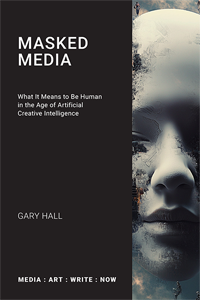
Book: Masked Media: What It Means to Be Human in the Age of Artificial Creative Intelligence, 2025

Journal issue: Ecologies of Dissemination issue of PARSE Journal #21 - Summer, 2025, edited by Eva Weinmayr and Femke Snelting. (I am one of the contributors to this experimental issue which emphasizes collective, community-based and relational practices of knowledge production over individual authorship.) 

AI Magazine: Robot Review of Books

Some recent and not-so-recent publications

A Brief History of Writing: From Human Meaning to Pattern Recognition and Beyond, with Joanna Zylinska

Experimental Publishing Compendium

Combinatorial Books: Gathering Flowers (book series)

‘How To Be A Pirate: An Interview with Alexandra Elbakyan and Gary Hall by Holger Briel’.

'Experimenting With Copyright Licences' (blogpost for the COPIM project - part of the documentation for the first book of the Combinatorial Books pilot)

Contribution to 'Archipiélago Crítico. ¡Formado está! ¡Naveguémoslo!' (invited talk: in Spanish translation with English subtitles)

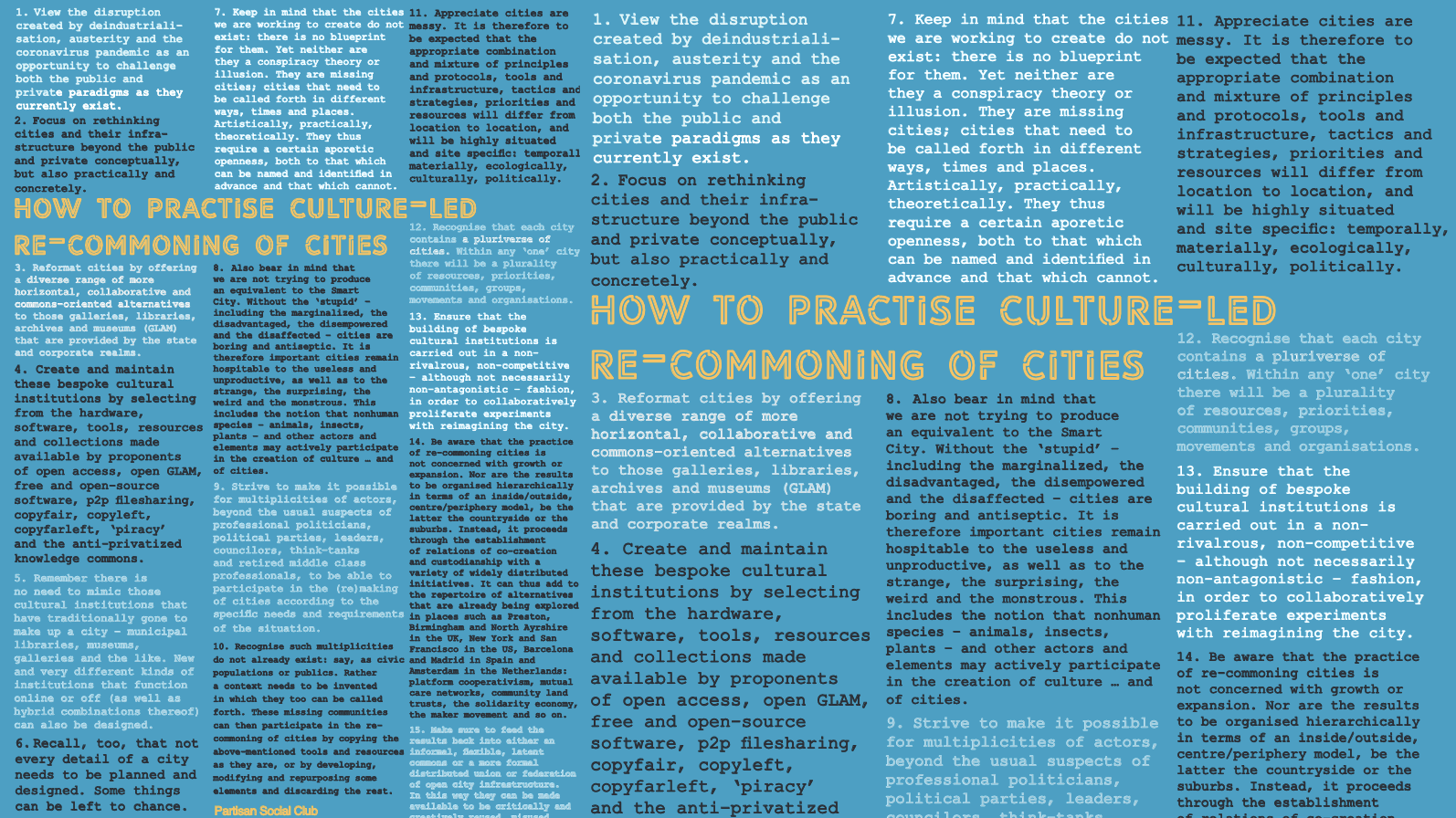
How to Practise the Culture-led Re-Commoning of Cities (printable poster), Partisan Social Club, adjusted by Gary Hall

'Writing Against Elitism with A Stubborn Fury' (podcast)

'The Uberfication of the University - with Gary Hall' (podcast)

'"La modernidad fue un "blip" en el sistema": sobre teorías y disrupciones con Gary Hall' ['"Modernity was a "blip" in the system": on theories and disruptions with Gary Hall']' (press interview in Colombia)

'Combinatorial Books - Gathering Flowers', with Janneke Adema and Gabriela Méndez Cota - Part 1; Part 2; Part 3 (blog post)

Open Access

Most of Gary's work is freely available to read and download either here in Media Gifts or in Coventry University's online repository PURE here, or in Humanities Commons here

Radical Open Access

Radical Open Access Virtual Book Stand

'"Communists of Knowledge"? A case for the implementation of "radical open access" in the humanities and social sciences' (an MA dissertation about the ROAC by Ellie Masterman). 

Thursday
May212026

Commonwealth Short Story Prize AI Plagiarism Controversy

The current controversy over the winner of the prestigious Commonwealth short story prize, prompted by the presence of supposedly obvious indicators of AI plagiarism and fraud, points to a much wider issue than simply whether the text in question, ‘The Serpent in the Grove’, was created by a human (from the Global South) or by a machine.

https://africasacountry.com/2026/05/how-to-read-postcolonial-writing

https://www.jamaicaobserver.com/2026/05/15/trinidadian-cops-commonwealth-short-story-prize-caribbean/

https://www.theguardian.com/books/2026/may/19/commonwealth-short-story-prize-winner-doubts-ai-artificial-intelligence

It’s in response to precisely these kind of human-vs-AI debates that the design-art collective COPODE and I have launched the 100% Inhuman Made badges project:

Rather than attempting to restore or defend the idea of the soveriegn human author against (the use of) AI, the 100% Inhuman Made project asks whether any work has ever been purely human-made. Writing and cultural production have always depended on distributed systems involving not only ‘authors’, but also institutions, infrastructures, technologies, environments and often invisible forms of labour.

From this perspective, AI is not an absolute rupture so much as the latest addition to already complex assemblages of human and nonhuman actors.

The project launched with an announcement on the London School of Economics Impact Blog titled “Nothing is ‘100% human authored’”:

There is also a project page here. 

At the heart of the initiative is a series of generative badges carrying messages such as ‘100% Inhuman Made: Some AI Used’. Unlike fixed certification marks (e.g. ‘100% Human Made: No AI Used’), each badge exists only temporarily: every click produces a new version, while the previous one disappears. The project therefore resists ideas of originality, fixity and singular ownership, unfolding instead through reuse, circulation and transformation.

The badge generator is here.

So the project is part conceptual intervention, part generative artwork and part open experiment in how ideas circulate. 

The intention is not to dismiss concerns about AI, the environment or labour, but to open up a broader debate about creativity, authorship and the human at a moment when all three are being renegotiated and reframed.


Monday
May182026

Sigi Jöttkandt, Joanna Zylinska & Gary Hall, 'Friendship, and Other Ways of Producing Knowledge', Scholē IRL podcast on OHP 

'Friendship, and Other Ways of Producing Knowledge', with Sigi Jöttkandt, Joanna Zylinska and Gary Hall, Scholē IRL, April 29, 2026.

'This week, we are joined with Sigi Jöttkandt, Joanna Zylinska, and Gary Hall, the Directors of the Open Humanities Press,  an international community of scholars, editors and readers with a focus on critical and cultural theory and a mission to make leading works of contemporary critical thought available worldwide. OHP has operated as an independent initiative since 2006, promoting open access scholarship in journals, books and exploring new forms of scholarly communication. OHP’s organization is a community-interest company headquartered in London. The OHP Editorial Board is at the heart of all their activities: participating in journal assessments, reviewing and approving book series proposals, performing and managing peer review, and editing the OHP book series. They act on the principles of access, scholarship, diversity and transparency. They have also partnered with a number of groups and institutions to explore grass-roots solutions to the crisis in Humanities publishing.'


Monday
May112026

Response to 'Is Social Media Antithetical to Academic Life?'

What follows is a response to 'Spetacularisation, Ephemerality and Narcissism – Is Social Media Antithetical to Academic Life?', by Fernando Viannam, Rafael Alcadipani and Isleide Arruda Fontenelle, published on the LSE Impact blog, May 6th, 2026: 

---

Fernando, Rafael and Isleide, 

You argue powerfully that the idea that social media is essential to academic life in the 21st century rests on a questionable assumption: namely, that social media simply amplifies academic work.

But I can't help wondering whether your research - at least as it is presented here - risks resting on a questionable assumption of its own? That core academic values and forms of communication should not themselves be subject to critical examination (at least not to the same extent as social media); that they can instead remain unmarked, masked, blacked-boxed, almost as an 'unquestioned good' against which social media can be measured and found wanting?

To build on your argument, should we not also find ways of using books, journals, conferences and talks more critically - that is, those conventional (non-social media) forms of communication that academics find essential and rely on to disseminate their work, build networks, increase visibility? How have these media (and the underlying logics through which they operate, embedded as they are within a capitalist economy and a system of liberal humanism) functioned, not merely as neutral vehicles for amplifying research and scholarship, but also as forces that shape how academic work is produced, experienced and evaluated?  Indeed, how have these media served to transform academics themselves? 

You show - extremely persuasively and incisively - how social media 'actively reorganizes academic life through three dynamics: spectacularisation, ephemerality, and academic narcissism.' What, then, would you say are the equivalent core values, concepts and dynamics by which books, journals and related forms organize academic life?

Complexity, nuanced argument, intellectual exchange and engagement, substance, slow thinking, sustained attention, cumulative dialogue, contributions to collective knowledge?

Or should we adopt a more critical stance here as well? If so, might we identify other organising assumptions and values: copyright and IP, the proprietorial human subject, the rational liberal individual as ultimate source of knowledge and authority, the unified, fixed, autograph text, fixed expression, linear sequential argument, for-profit publishing. 

In that sense, the challenge may not simply be to resist the dynamics of social media, but also to  'do differently' with respect to these inherited forms of academic communication.

Which  - to build on your argument one last time - perhaps raises another difficult but necessary question: why have we accepted, and why do we continue to accept, this model so readily, too? 


Thursday
May072026

2nd edition of The Chernobyl Herbarium: Fragments of an Exploded Consciousness 

Together with Michael Marder and Anaïs Tondeur, we invite you to mark the 40th anniversary of the Chernobyl nuclear disaster with the second edition of The Chernobyl Herbarium: Fragments of an Exploded Consciousness.

The book is available as a free download via Open Humanities Press:

https://www.openhumanitiespress.org/books/titles/the-chernobyl-herbarium-2nd-ed/

'We entrust readers with forty fragments of reflections, meditations, recollections, and images — one for each year that has passed since the explosion… Through words and images, we wish to contribute our humble share to a collaborative grappling with the event of Chernobyl… taking stock of the consciousness it fragmented and, perhaps, cultivating another, more environmentally attuned way of living.'

Unthinkable and, in many ways, unrepresentable, Chernobyl continues to shape how we understand technology, ecology and responsibility. This edition offers a collective space for reflection - through text and images - on what it means to live with its aftermath.

---

Also, don't forget to check out our earlier Ecological Rewriting: Situated Engagements With The Chernobyl Herbarium, edited by Gabriela Méndez Cota

https://www.openhumanitiespress.org/books/titles/ecological-rewriting/

Ecological Rewriting: Situated Engagements with The Chernobyl Herbarium (2023) was the first book in OHP's Combinatorial Books: Gathering Flowers series. Supported by the COPIM project, it was the creation of a collective of researchers, students and technologists from the Universidad Iberoamericana in Mexico City. Led by Gabriela Méndez Cota, this group of nine (re)writers annotated and remixed The Chernobyl Herbarium: Fragments of an Exploded Consciousness (2015) by the philosopher Michael Marder and the artist Anaïs Tondeur (originally published in OHP’s Critical Climate Change series) to produce what is a new book in its own right – albeit one that comments upon and engages with the original.

The online version of Ecological Rewriting is an experimental publication with links to the original annotations that the group of authors made on The Chernobyl Herbarium, so that the reader can follow an associative trail between the two publications.


Wednesday
Mar252026

'Defund Culture by Any Means Necessary': Minor Compositions Podcast Season 2 Episode 5 

'Defund Culture by Any Means Necessary': Minor Compositions Podcast - Season 2, Episode 5, with Gary Hall and Seth Wheeler, hosted by Stevphen Shukaitis

https://www.minorcompositions.info/?p=1885

YouTube: https://youtu.be/mk-j2uh9cdk

Now available on all the usual podcast platforms.

In this episode owe are joined by Gary Hall and Seth Wheeler for a wide-ranging conversation on cultural funding, radical publishing, and the changing conditions of collective knowledge production.The discussion begins with Gary Hall’s recent book Defund Culture: A Radical Proposal, which challenges conventional calls to increase arts funding by asking a more fundamental question: what – and who – is cultural funding actually for? Rather than defending existing institutions, Hall proposes that the current crisis in arts funding might be an opportunity to rethink the entire landscape, redistributing resources away from entrenched, upper-middle-class infrastructures toward more collective, plural, and relational forms of cultural production. 

From there, the conversation moves into the practical and political challenges of radical publishing today. Reflecting on projects such as Open Humanities Press and Agit Press, Hall and Wheeler discuss the tensions between openness and enclosure in contemporary publishing, the uneven realities of open access, and the difficulty of sustaining collective, non-commercial forms of intellectual work. Wheeler draws on experiences from worker movements to highlight the historical role of print media – newsletters, pamphlets, and leaflets – as machines to produce consciousness, capable of expanding political dialogue beyond academic and activist enclaves.How do these earlier forms resonate with, and diverge from, today’s digital platforms? What happens when knowledge production becomes entangled with the logics of content creation, personal branding, and algorithmic visibility? The conversation explores how financial precarity and platform economies shape what can be said, by whom, and under what conditions: raising questions about whether genuinely collective and autonomous forms of media can exist within, or beyond, these systems.

Ultimately this is a question of infrastructure: how to build alternative networks for producing and distributing knowledge that do not simply replicate existing hierarchies. From decentralized publishing models and cooperative platforms to the enduring importance of print as a social and organizational process, the episode maps out both the challenges and the possibilities of creating new cultural forms grounded in collaboration, redistribution, and shared intellectual life. Rather than offering definitive solutions, this conversation opens up a space for thinking through what it might mean to defend/defund culture by transforming it – experimenting with new modes of publishing, new institutional arrangements, and new ways of working together.

More on the book, Defund Culture: A Radical Proposal: https://www.mediastudies.press/pub/nb-hall-defund/release/4
Open Humanities Press: https://openhumanitiespress.org
Agit Press: https://www.agitpress.net

Intro / outro music – Mischief Brew, The Reinvention of the Printing Press